Arcana Discipline Foundry
  • Home
  • About Us
  • Frameworks
    • ASRF
    • CGSF
  • Arcana Blog
  • Contact Us
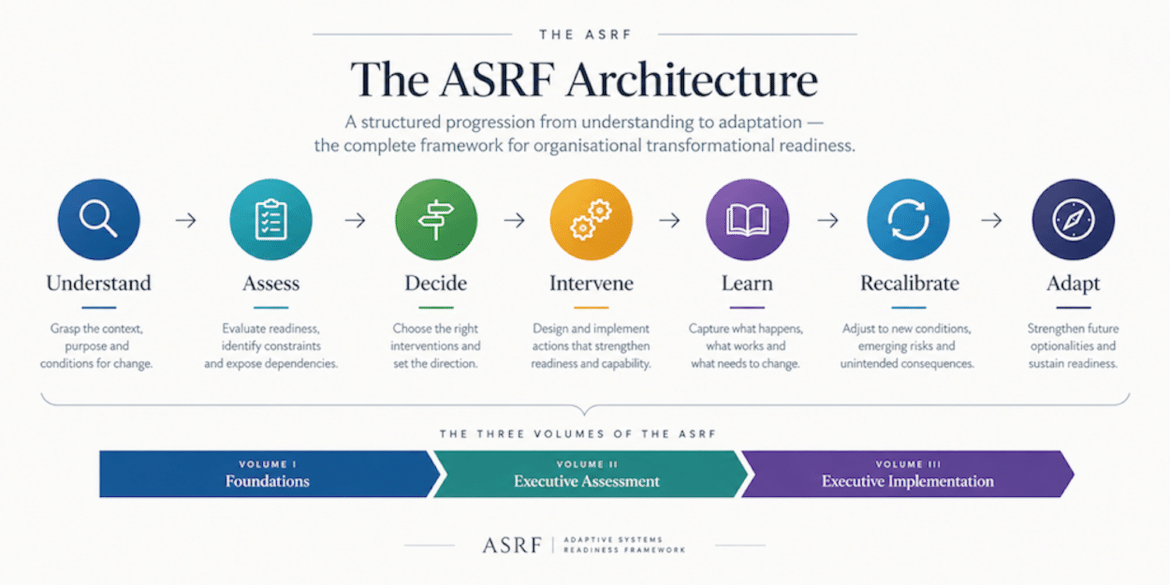
ASRF Architecture Graphic

The Adaptive Systems Readiness Framework (ASRF)

by V8mondo 25 September 2026

A Professional Reference Library for Organisational Transformational Readiness

Transformation has become a permanent feature of organisational life.

  • Artificial intelligence.
  • Automation.
  • Regulatory change.
  • Restructuring.
  • Digital transformation.
  • New operating models.
  • Acquisitions.
  • Geopolitical disruption.

The question for leaders is no longer simply whether their organisation needs to change, It is whether the organisation can change effectively, remain governable while changing, and retain the capacity to change again.

That is exactly the problem addressed by the Adaptive Systems Readiness Framework (ASRF).

The complete three-volume library has now been published.

A Professional Reference Library

The ASRF has been developed as a professional reference library for Organisational Transformational Readiness.

It provides a structured discipline for examining the conditions that influence an organisation’s ability to understand, assess, decide upon, implement, and adapt to transformational change.

The Three Volumes Form a Deliberate Progression.

Volume I: Foundations

Foundations, establishes the conceptual architecture of organisational transformational readiness.

It examines the underlying relationship between capability, coherence, governance, adaptability, dependencies, constraints, and organisational change.

The central concern is understanding what readiness actually means, when an organisation is operating within a changing environment.

Volume II: Assessment

Assessment, moves from conceptual foundations towards structured organisational assessment.

It considers how leaders can examine readiness conditions, identify constraints, understand dependencies, and distinguish apparent capability from the organisational capacity required to sustain transformation.

The emphasis is not simply on asking whether an organisation is ready, It is on understanding ‘why’ it is ready, where readiness is constrained, and where apparent readiness may conceal emerging weaknesses.

Volume III: Implementation

Implementation, completes the library by addressing intervention. Readiness has limited value, if it does not improve decision-making.

The third volume examines how leaders can move from assessment towards action: designing interventions, addressing organisational constraints, considering dependencies and reversibility, observing consequences, and recalibrating as conditions change.

The architecture has a logical progression. (See ASRF Architecture Graphic above.)

So, Why Should Business Leaders Care?

A transformation programme does not operate independently of its organisation.

It operates through it. That means the quality of a transformation depends partly upon conditions that may sit outside the programme itself.

  • Decision rights.
  • Governance.
  • Organisational coherence.
  • Capability.
  • Dependencies.
  • Coordination.
  • Operational pressure.
  • Leadership capacity.
  • Technology architecture.
  • Institutional constraints.

These conditions can determine whether an otherwise credible transformation remains executable, when circumstances change.

The ASRF provides a way of making those conditions more visible.

We Have Not Forgotten About Business Executives

For executives, the ASRF offers a structured way to examine a question that conventional programme reporting may not fully answer:

What is happening to the organisation’s capacity to change, while we are changing it?

A transformation can increase capability, while reducing flexibility.

  • It can strengthen control, while increasing coordination demand.
  • It can deliver immediate benefits, while creating longer-term dependencies.
  • It can succeed against its original objectives, while reducing future optionality.

These are not necessarily reasons to stop a transformation. They are reasons to understand its consequences.

We Have Considered Project and Programme Leaders

For project and programme professionals, the ASRF provides a broader organisational context for the friction encountered during execution.

  • Delayed decisions.
  • Competing priorities.
  • Unresolved dependencies.
  • Escalation bottlenecks.
  • Governance complexity.
  • Operational resistance.
  • Resource constraints.
  • Repeated workarounds.

These might appear to be individual project problems, but sometimes they are symptoms of a deeper organisational condition. Understanding that distinction can materially change the way intervention is designed.

We Also Designed For Investors and Advisors

For investors, strategic advisors, and those assessing organisational value, the ASRF introduces another question into the analysis of transformation:

Does the organisation possess the capacity required to execute its future?

Financial resources and strategic ambition are important, so are technology, market position, leadership, and capital allocation. But the ability to convert those resources into sustained organisational change, is itself a form of capability.

The organisation’s ability to adapt after that change, can be equally significant.

The ASRF provides a conceptual lens, for examining something that can be difficult to see in conventional reporting: Future Organisational Optionality.

A Completed Body of Work

The publication of all three volumes marks an important point in the development of the ASRF.

This is no longer a proposition contained within a single book, it is a complete reference library.

Volume I: establishes the foundations.

Volume II: provides the executive assessment discipline.

Volume III: addresses implementation and intervention.

Together, they provide a coherent body of work around a single management problem:

How can organisations remain capable of governing and adapting, while undergoing continuous transformation?

A Question That Extends Well Beyond AI

The question extends beyond any particular technology. It also extends beyond any single transformation programme. It is fundamentally a question about organisational capability, in conditions of continuous change.

The Wider Arcana Foundry

The ASRF is also the first completed expression of a broader programme of research and framework development, at Arcana Discipline Foundry.

The Foundry’s work is concerned with identifying emerging organisational problems, and then developing structured professional disciplines around them.

The objective is not to create frameworks for the sake of creating frameworks.

It is to build a body of intellectual property capable of addressing difficult questions of governance, transformation, stewardship, continuity, and organisational capability.

Further frameworks are already in development.

The Capital Governance & Stewardship Framework (CGSF) represents one such emerging discipline, examining questions surrounding governance, stewardship, enduring wealth, and the responsibilities associated with capital across time.

The ASRF and CGSF are distinct bodies of work.

Together, however, they illustrate the broader direction of Arcana Foundry: researching and forging tomorrow’s disciplines today.

The ASRF library is complete, but the discipline continues.

The three-volume set of the ASRF is now available as a complete professional reference library.

For leaders, it provides a framework for thinking beyond transformation delivery.
For executives, a structured perspective on organisational readiness and intervention.
For project and programme professionals, a way of understanding the organisational conditions surrounding execution.
For advisors and investors, another lens through which organisational capability, adaptability, and future optionality can be considered.

The underlying proposition is simple:

An organisation’s ability to change is itself a strategic capability.

Understanding that capability, could be essential to understanding the organisation’s future.


The Adaptive Systems Readiness Framework (ASRF)
Advancing the Discipline of Organisational Transformational Readiness

ASRF: Executive Reference Library
Executive thinking for adaptive organisations


Arcana Discipline Foundry
Researching and Forging Tomorrow’s Disciplines Today

Discover • Define • Endure


Adaptive Systems Readiness Framework (ASRF)®, Executive Reference Library®, Capital Governance & Stewardship Framework (CGSF)®, The Foundry Method®, Arcana Discipline Foundry® are trading styles of Rogers AI Consult & Arcana Discipline Foundry

© 2026 Raymond Rogers | All Rights Reserved | Arcana Discipline Foundry® | Researching and Forging Tomorrow’s Disciplines Today® | Rogers AI Consult | Frameworks for Problems That Matter
25 September 2026 0 comments
0 FacebookTwitterPinterestEmail
Article: When does a framework become a discipline?

When Does a Framework Become a Discipline?

by V8mondo 19 August 2026

Every year, new frameworks are introduced to address emerging challenges.

Some become widely adopted within organisations, and others influence industries for a period, before gradually fading from use. Many provide genuine value, offering structured approaches to complex problems and helping practitioners make better decisions.

Frameworks matter.

They organise ideas, establish common language, and provide practical guidance where uncertainty exists. Yet, an important question is rarely asked.

When does a framework cease to be a simple framework, and begin to emerge as a discipline?

This distinction is more significant than it first appears.

The Purpose of a Framework

A framework is primarily a means of organising knowledge. It identifies relationships, provides structure, and offers practical methods for addressing a defined problem. Frameworks are designed to be useful. They simplify complexity, and assist decision-making within a particular context.

Most successful frameworks possess clarity, flexibility, and practical relevance. However, they often remain dependent upon the disciplines from which they originated.

  • Management frameworks draw upon organisational theory.
  • Financial frameworks draw upon economics.
  • Technical frameworks draw upon engineering, or computer science.

In most cases the framework applies existing knowledge, rather than establishing new conceptual foundations.

There is nothing inherently limiting about this. Indeed, many of the world’s most influential frameworks have achieved, precisely because they have translated established knowledge into practical application.

But occasionally, something different begins to emerge.

When Existing Disciplines No Longer Provide Sufficient Explanation

There are moments, when an emerging phenomenon resists explanation through any single established discipline. The phenomenon might involve technology, governance, economics, organisational behaviour, ethics, systems thinking, and public policy simultaneously.

Each discipline contributes valuable insight, but none provides a complete explanation.

The result is often an accumulation of overlapping models, fragmented terminology, and competing interpretations. Practitioners might sense that something important is occurring, yet lack a coherent language with which to describe it.

This is frequently the point at which new frameworks begin to appear.

Most remain exactly that, but a small number might be signalling something much larger.

Beyond Structure

A discipline requires more than organised knowledge, it requires a coherent conceptual foundation, capable of supporting continuing research, critical examination, and progressive refinement.

  • Its principles should be internally consistent.
  • Its terminology should be clearly defined.
  • Its propositions should be capable of challenge and development.
  • Its methods should extend beyond immediate application to support education, assessment, and future inquiry.

Perhaps, most importantly, a discipline should possess explanatory power. It should help people understand, not only ‘what’ to do, but ‘why’ a phenomenon behaves as it does.

The Characteristics of an Emerging Discipline

Although every discipline develops differently, several characteristics often begin to appear as maturity increases.

An emerging discipline is likely to develop:

  • First principles that define its conceptual foundations.
  • A Canon that establishes its scope, purpose, and assumptions.
  • A Lexicon that provides consistent terminology.
  • Assessment methods that enable systematic application.
  • A body of literature, capable of supporting education and continuing research.
  • Practical guidance that evolves through evidence, rather than assertion.

These characteristics are not created simultaneously, they emerge progressively as understanding deepens.

The transition, from framework to discipline, is seldom a single event. It is an evolutionary process.

Patience Before Permanence

There is a temptation, to declare new disciplines prematurely.

Novel terminology, persuasive models, or commercial success can create the appearance of conceptual maturity, before the underlying foundations have been adequately examined. History suggests caution.

Enduring disciplines are recognised, not because they are announced, but because they consistently demonstrate their value over time.

  • They survive critical examination.
  • They adapt without losing coherence.
  • They continue to explain phenomena as knowledge expands.

Recognition follows contribution, not the other way around.

Looking Forward

The pace of change across technology, governance, and society will continue to generate questions that challenge existing fields of knowledge. Some will be answered, through the continued evolution of established disciplines. Others, may gradually reveal the need for entirely new conceptual foundations.

Determining which path is appropriate requires patience, evidence, and disciplined inquiry.

Frameworks will continue to play an essential role, yet we should remain open to the possibility that, on occasion, a framework is not simply organising existing knowledge.

It might be revealing the early foundations of a discipline that has yet to be fully recognised.

The responsibility of research, is not to declare that moment prematurely, but to recognise it when the evidence becomes impossible to ignore.

19 August 2026 0 comments
0 FacebookTwitterPinterestEmail
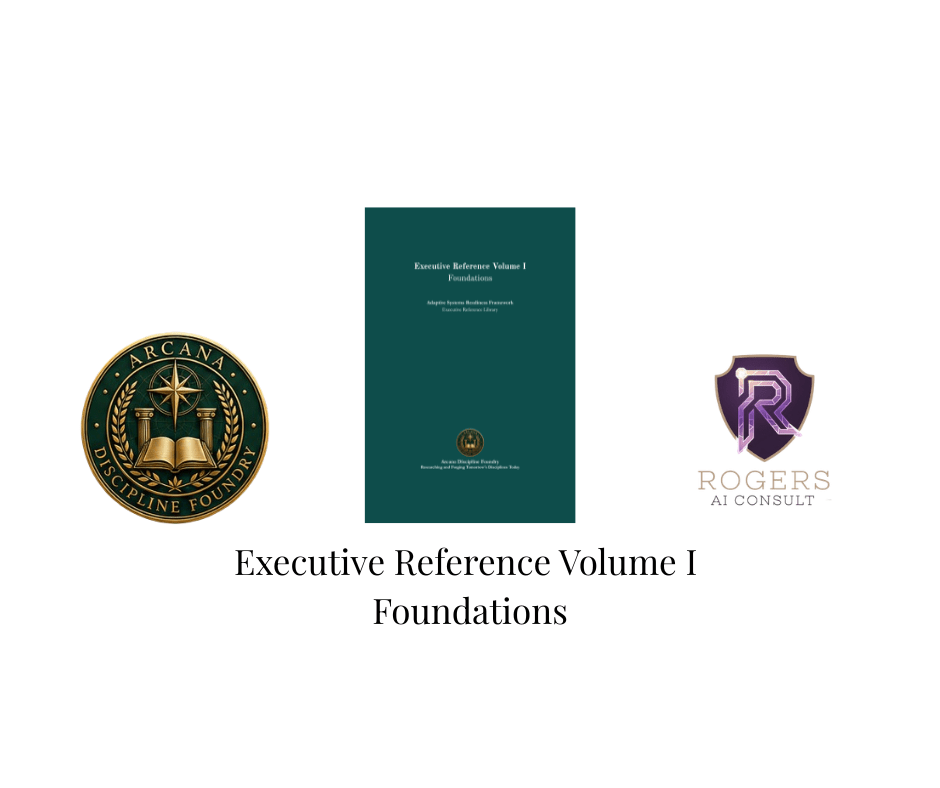
Banner ad for Book Publication - Executive Volume I - Foundations ASRF

The Executive Reference Volume I – Published via Amazon

by V8mondo 19 August 2026

Adaptive Systems Readiness Framework (ASRF)

Executive Reference Library

Volume I : Foundations

  • Establishes the conceptual foundations of organisational transformational readiness.
  • Examines the readiness illusion, organisational coherence, adaptive capacity, governance, and the underlying problem the ASRF addresses.

Volume II : Assessment

  • Focuses on assessing organisational readiness in practice.
  • Develops the diagnostic and assessment architecture, including the conditions affecting governability, adaptive capacity, dependency, continuity, and transformational resilience.

Volume III : Implementation

  • Focuses on applying the ASRF within organisations.
  • Addresses implementation, intervention, governance in practice, maintaining readiness, and translating assessment findings into organisational action.

The Adaptive Systems Readiness Framework (ASRF) : Executive Reference Library is a new body of executive knowledge developed for leaders navigating increasing organisational complexity, accelerating technological change, and strategic uncertainty.

Forged at Arcana Discipline Foundry, the ASRF was developed as a management discipline, for understanding the organisational conditions that determine an enterprise’s continuing capacity to evolve.

Rather than offering another leadership model, or AI implementation guide, the ASRF examines a more fundamental executive question:

What conditions must remain intact, for an organisation to continue adapting successfully as its environment changes?

It is built on a simple, but consequential premise:

“Long-term organisational success is determined, not only by performance, but by the conditions that make sustained adaptation possible.”

The Executive Reference Library develops this premise across three volumes, establishing the foundations of Adaptive Readiness, developing its assessment and diagnostic dimensions, and extending its application into executive decision-making.

Designed as a professional executive reference library, the ASRF series is intended for Boards, executive leadership teams, investors, governance and risk professionals, auditors, transformation leaders, and organisational practitioners seeking a more structured understanding of organisational adaptability, governability, and future capacity.

The ASRF is not designed around a single technology, sector, or anticipated future.

It is designed, around the enduring executive challenge of ensuring that organisations remain capable of responding to futures that cannot yet be fully known.

19 August 2026 0 comments
0 FacebookTwitterPinterestEmail

The Role of Canon: Why Every Discipline Needs First Principles

by V8mondo 19 August 2026

Every enduring discipline, begins long before its methods become widely adopted. It begins by asking a more fundamental question.

What, precisely, is the discipline seeking to explain?

Without a clear answer, even the most practical framework risks becoming a collection of useful ideas, rather than a coherent body of knowledge. This is why the concept of a Canon matters. Not as a historical tradition, or an institutional formality, but as the intellectual foundation upon which every enduring discipline is built.

Beyond Methods and Models

When a new field begins to emerge, there is often pressure to produce immediate solutions.

Organisations seek implementation, and markets reward application. These are understandable priorities, however, application without foundation can create a fragile structure. Methods might prove useful for a time, yet become increasingly difficult to adapt as new evidence emerges. Terminology begins to drift, assumptions become inconsistent, and different interpretations develop without a shared conceptual anchor.

Eventually, the framework risks losing coherence.

The problem is rarely the quality of the methods themselves.

The problem is that the foundations were never fully established.

What Is a Canon?

As someone who has drafted and edited a number of Canon’s, in relation to emerging frameworks, I can tell you that they are a necessary document to enable the birth of any new discipline.

But a Canon is not a rulebook, neither is it a manifesto, it is actually the foundational statement of a discipline.

A canon:

  • Defines the phenomenon under investigation.
  • Establishes the scope of inquiry.
  • Articulates the discipline’s first principles.

Also, it explains why the discipline exists and the questions it seeks to answer. Perhaps most importantly, a Canon identifies what belongs within the discipline, and what does not.

In doing so, it provides the intellectual boundaries that enable coherent growth, without unnecessary constraint.

First Principles Before Application

Throughout history, enduring advances in knowledge have often begun by returning to first principles. Rather than asking how to improve existing methods, researchers first question the assumptions upon which those methods were built.

First principles encourage clarity, and they:

  • Separate observation from interpretation.
  • Distinguish evidence from assumption.
  • Provide a stable foundation, upon which future knowledge can be constructed.

Without first principles, any discipline risks simply becoming collection of practices, whose underlying purpose gradually becomes obscured.

With first principles, they gain resilience.

Methods will evolve, applications might diversify, but the conceptual foundation remains coherent.

The Canon as a Living Foundation

A Canon should never be regarded as a static document.

  • Knowledge evolves.
  • Evidence accumulates.
  • New questions emerge.

Consequently, the Canon must possess sufficient stability to preserve the identity of the discipline, while remaining open to thoughtful refinement, but this is not contradiction, It is the nature of disciplined inquiry.

A Canon provides continuity, without demanding permanence in every detail. Its purpose is not to prevent change, but to ensure that change occurs coherently.

Why Do Canon’s Matter?

Many contemporary frameworks begin with application. Only later, do they attempt to explain the conceptual assumptions upon which they depend. This sequence is understandable, but it can create difficulties.

When foundational assumptions remain implicit, interpretation becomes inconsistent. Practitioners develop different meanings for the same terminology, and researchers pursue divergent directions without recognising the underlying conceptual differences.

Over time, coherence weakens, but beginning with a Canon, reverses this process. The discipline establishes its foundations, before expanding its applications. Growth becomes cumulative, rather than fragmented.

Building for Endurance

Every discipline faces a choice. It can optimise for immediate adoption, or it can establish foundations capable of supporting decades of development. The two objectives are not incompatible, but they require different priorities.

Short-term success, often rewards simplicity and rapid implementation.

Long-term endurance depends upon conceptual clarity, coherent language, and a willingness to examine assumptions before drawing conclusions.

A Canon represents an investment in that long-term future.

It provides the reference point, against which future developments can be evaluated, refined, and, when necessary, challenged.

Arcana Discipline Foundry

The new frameworks developed at Arcana Foundry, namely the Adaptive Systems Readiness Framework (ASRF), and the upcoming, Capital Governance & Stewardship Framework (CGSF) are examples of how a Canon document steers the research and development of a new discipline, towards final publication.

The Canon documents for both of these frameworks, allowed them to reach publication without encountering unforeseen obstacles, or drifting off on tangents.

The Adaptive Systems Readiness Framework emerged to answer questions surrounding AI Adoption, where investment in new technologies faltered, due to existing system incompatibility.

During research for this new framework, it was soon apparent that the framework was resilient, and highly adaptable for use across the entire organisation. It could be applied in real-time for any type of system being adopted, changed, or developed.

The first Executive Volume for the Adaptive Systems Readiness Framework has now been published, and is available via Amazon. There are three Executive Volumes that provide an organisation of any size, with a complete methodology: Foundations, Assessment, and Implementation.

Conversely, the Capital Governance & Stewardship Framework (CGSF) is a governance discipline concerned with the readiness, stewardship, preservation, and continuity of productive capital across time. This emerging discipline, provides a framework to ensure wealth can endure across generations.

We can discuss the Reserch, Lexicon, Architecture, and Branding dcouments required to birth new disciplines, in future articles.

Conclusion

Disciplines do not endure because they possess the most sophisticated models, they endure because they possess the strongest foundations.

  • Methods will evolve.
  • Technologies change.
  • Contexts can shift.

Yet, a discipline grounded in clearly articulated first principles, retains its ability to interpret new realities, without losing its identity.

A Canon is not simply the beginning of a discipline.

It is the foundation, upon which every future contribution ultimately depends.

19 August 2026 0 comments
0 FacebookTwitterPinterestEmail

Where the Adaptive Systems Readiness Framework (ASRF) Was Forged

by V8mondo 10 August 2026

For those who have followed my work on the Adaptive Systems Readiness Framework (ASRF), there is a part of its story I have not previously made explicit.

The ASRF did not begin as a finished framework. It began with a problem.

Why were organisations being asked to become more adaptive, while the disciplines intended to govern them were still largely treating transformation as a collection of projects, technologies, controls, and capabilities?

That question led to another.

What happens when an organisation possesses the capability to change, but loses the coherence required to govern that change?

From those questions, the ASRF began to emerge.

The concepts came gradually.

  • Readiness.
  • Governability.
  • Adaptive manoeuvrability.
  • Continuity pressure.
  • Continuity hardening.
  • Retained recalibration capacity.
  • Governability degradation.

Each concept was tested, challenged, refined, and placed into a growing body of principles and relationships.

The result was not simply another AI framework. The ASRF became, an attempt to establish a different discipline for understanding organisational readiness in environments of continuous change.

But where did that framework come from?

It was forged at Arcana Foundry, using the Foundry Method.

Arcana Foundry is not another consultancy brand, nor is it intended to be a collection of disconnected ideas. It is the intellectual workshop in which new frameworks are researched, challenged, structured, and then developed.

The ASRF was its first major framework, and that is a distinction that really matters.

The Adaptive Systems Readiness Framework (ASRF), emerged from work initially concerned with AI adoption and governance, but its underlying questions proved considerably broader.

  • Risk professionals began engaging with the ideas.
  • Audit professionals recognised familiar problems.
  • Governance practitioners challenged assumptions.
  • Executives began considering what organisational readiness actually meant, beyond technology deployment.

Those conversations helped reveal something important: The problem was not simply AI.

AI had exposed a deeper organisational problem, and I came to realise that the same pattern can occur in other domains.

A discipline might possess sophisticated tools, established practices, and extensive professional expertise, yet it can still lack a coherent framework for addressing a particular emerging problem.

That is where Arcana Foundry begins its work.

From Problems to Disciplines

The purpose is not to create frameworks for the sake of creating frameworks, but to identify problems that existing disciplines might be attempting to solve, without fully explaining them.

The process begins with a question:

What important problem remains inadequately understood?

Then:

  • What assumptions underpin the existing diagnosis?
  • What does the established discipline already explain?
  • Where does it stop?
  • What patterns appear beyond that boundary?
  • What terminology is missing?
  • Can those patterns be organised into a coherent model?
  • Can the model be tested?
  • Can it eventually, become useful enough to constitute a discipline in its own right?

This is the thinking that produced the ASRF, and it is the thinking that will guide what comes next.

The Next Questions

The work at Arcana Foundry, is now beginning to extend beyond organisational adaptability.

Some of the questions concern capital continuity, others concern stewardship. Some emerged from risk, audit, assurance, leadership, or entirely different fields.

One emerging example, is the Capital Governance & Stewardship Framework (CGSF), a governance discipline for the continuity of enduring value, exploring how stewardship, governance, and successive responsibility preserve assets, institutions, and legacy across generations.

Its premise began with a deceptively simple observation:

Financial capability does not necessarily imply stewardship capability.

We teach people how to earn and invest — saving is not recommended — but what prepares someone to govern substantial capital?

What happens when financial success arrives suddenly?

How does decision-making change when capital becomes sufficient to sustain a life, a family or generations?

How should capital be governed, rather than merely invested?

These are not simply investment questions, they are questions of governance, leadership, psychology, continuity, and stewardship.

That is precisely the kind of boundary that interests Arcana Foundry.

The Connection

For those who have followed my work on the ASRF, please understand that this is not a departure from what came before. It is an explanation of where it came from.

The ASRF was forged at Arcana Discipline Foundry, to give it its full title, along with the Executive Reference Library.

The Executive Reference Library, the research surrounding the ASRF, its evolving lexicon, and its assessment concepts are all part of that development process. Arcana Foundry is the workshop.

The frameworks are what emerge from the workshop, but the objective is not to predict which discipline comes next. It is to discover where existing thinking is no longer sufficient, and determine whether a new framework is warranted.

The Capital Governance & Stewardship Framework (CGSF), is emerging with its own library too. The CGSF Legacy Continuity Library will begin to grow, like the ASRF: Executive Reference Library, which currently has three volumes ready to publish in September 2026, and a further volume being edited.

These are relatively humble beginnings, but the work continues, with new frameworks and emerging disciplines being explored, researched, and developed.

Our Foundational Philosophy:

Disciplines are discovered through disciplined inquiry, before they are formalised through disciplined design.

Arcana Discipline Foundry
Researching and Forging Tomorrow’s Disciplines Today

Discover • Define • Endure

Adaptive Systems Readiness Framework (ASRF)®, Capital Governance & Stewardship Framework (CGSF)®, The Foundry Method®, Arcana Discipline Foundry® are trading styles of Rogers AI Consult & Arcana Discipline Foundry

© 2026  Raymond Rogers | All Rights Reserved | Arcana Discipline Foundry® | Researching and Forging Tomorrow’s Disciplines Today

10 August 2026 0 comments
0 FacebookTwitterPinterestEmail

Executive Frameworks Are Not Built in Isolation

by V8mondo 8 August 2026

Every executive framework reaches a point, where its greatest source of improvement is no longer its creator.

It is the quality of the questions asked by the people who apply it.

One of the most rewarding aspects of developing the Adaptive Systems Readiness Framework (ASRF), has been the calibre of the professionals engaging with its ideas.

Risk leaders, finance executives, governance practitioners, systems architects, AI specialists, and organisational leaders have each challenged different parts of the framework, not by rejecting its principles, but by testing its boundaries.

That process has reinforced an important conclusion.

Executive disciplines do not become stronger by avoiding scrutiny, they become stronger because of it.

Recently, several conversations I have had, in relation to this very topic, have highlighted this perfectly.

One finance executive, questioned how organisational readiness translates into investment decisions, and long-term capital allocation.

Several Governance professionals, challenged the distinction between compliance and governability, reinforcing the principle that regulatory conformity alone, cannot preserve an organisation’s adaptive capacity.

A forward-thinking systems architect, introduced an important adjacent perspective: before an intelligent system determines what it should do, it must first determine where it is. That observation sits at the execution layer of governance, complementing, rather than competing with organisational readiness.

Each conversation sharpened the framework, but none required the underlying architecture to be abandoned. Instead, each helped define its boundaries more clearly.

This is how mature executive disciplines evolve, not through constant reinvention, but through disciplined refinement.

The Adaptive Systems Readiness Framework, was never intended to become a static methodology. Organisations, markets, and technologies evolve. Governance itself continues to evolve. A framework designed for executive decision-making must therefore, remain capable of learning without losing coherence.

That is why my, Executive Reference Library, has been conceived as a continuing body of work, rather than a fixed publication series.

The first volumes establish the foundations of adaptive readiness:

  • What organisational readiness actually means;
  • How readiness differs from technical capability;
  • How governability can be assessed, before transformation accelerates.

Future volumes will extend these ideas into emerging executive questions; informed by practice, evidence, and constructive challenge from leaders working across governance, investment, assurance, transformation, and technology.

This is not a search for consensus. Healthy governance depends upon thoughtful disagreement.

The objective is not to produce a framework that answers every question, but one that continues asking better questions as organisations become increasingly adaptive. Ultimately, executive frameworks should not be measured by how confidently they present answers, they should be measured by whether they improve executive judgement.

That remains the purpose of the Adaptive Systems Readiness Framework.

As the conversations continue, so too, will the framework.

Readiness is never static, and neither should be the discipline that seeks to understand it.

What executive question do you believe, organisations will need to answer five-years from now, which today’s governance models cannot yet explain?

8 August 2026 0 comments
0 FacebookTwitterPinterestEmail

Why the Future May Require New Disciplines

by V8mondo 6 August 2026

Introduction

Every generation inherits disciplines that were developed to explain the challenges of their time.

Engineering emerged to solve problems of infrastructure and industry. Economics sought to understand markets and value. Medicine advanced through centuries of observation and scientific inquiry.

Each discipline evolved, because existing knowledge proved insufficient to explain increasingly complex phenomena.

Today, we’re entering another period of profound transformation.

Artificial intelligence, autonomous systems, demographic change, institutional complexity, digital governance, and the accelerating pace of technological innovation are reshaping the environments in which organisations, governments, and societies operate.

Many of these developments challenge assumptions that have remained largely unchanged for decades.

The natural response is often to extend existing models. New frameworks are proposed. Additional regulations are introduced. Established theories are adapted, in an effort to explain phenomena they were never originally designed to address.

Sometimes this approach succeeds, and sometimes it does not.

The Limits of Existing Disciplines

Every discipline possesses strengths, but every discipline also possesses boundaries.

Problems arise, when new phenomena emerge that exist between established fields of knowledge. Such phenomena often resist simple classification. They draw upon elements of governance, technology, economics, organisational behaviour, ethics, systems thinking, and public policy simultaneously.

When this occurs, existing disciplines might provide valuable insight, but no single discipline offers a sufficiently coherent explanation.

The result is often conceptual fragmentation.

Organisations accumulate models, terminology, methodologies, and competing perspectives without developing a unified understanding of the underlying problem. Complexity increases, yet coherence declines.

This is not necessarily a failure of existing disciplines.

It may indicate that a genuinely new discipline is beginning to emerge.

Frameworks Are Not Always Enough

Frameworks perform an important role, they organise knowledge, provide practical guidance, and support decision-making within established domains. However, a framework alone does not constitute a discipline.

An enduring discipline requires something more fundamental.

  • Clearly defined first principles.
  • Coherent conceptual language.
  • Propositions capable of examination, and refinement.
    Methods of assessment.

An expanding body of knowledge that can mature through evidence, and practical application.

Without these foundations, frameworks often remain valuable tools, but rarely evolve into enduring fields of study.

The Importance of Disciplined Inquiry

New disciplines should never be created, simply because existing ones appear inconvenient. They must emerge through careful observation, rigorous questioning, continual refinement, and evidence. Disciplined inquiry begins, not with answers, but with uncertainty.

It asks, whether the phenomenon itself has been correctly understood.
It examines assumptions, before constructing models.
It seeks coherence, before complexity.

Only when existing explanations consistently prove insufficient, should the possibility of a new discipline be seriously considered.

This approach demands patience. It requires a willingness to reject attractive ideas that fail under examination, while remaining open to concepts that reveal themselves only through sustained research.

Towards Enduring Disciplines

Throughout history, enduring disciplines have not been established by declaration. They have earned recognition, because they provided clearer explanations, more coherent principles, and more useful methods than those available before them.

The same standard should apply today.

Emerging governance challenges deserve more than isolated models, or fashionable terminology. They deserve disciplined inquiry, capable of determining whether entirely new conceptual foundations are required.

If so, those disciplines should be discovered carefully, developed rigorously, and refined continually.

Their value should be measured, not by novelty, but by their ability to improve understanding, and strengthen responsible decision-making.

Conclusion

The pace of change will continue to accelerate. The questions confronting organisations, institutions, and society will become increasingly complex. Some will be answered, by extending established knowledge, and yet others may require something more fundamental.

The purpose of disciplined research is not to manufacture new disciplines for their own sake, but to recognise when the evidence suggests that new conceptual foundations have become necessary.

The future will not require more frameworks, simply because the world has become more complicated.

It may require new disciplines, because the questions themselves have changed.

That possibility is worth exploring with patience, evidence, and intellectual discipline.

Arcana Foundry Management Frameworks and Foundry Methodology
6 August 2026 0 comments
0 FacebookTwitterPinterestEmail

Why the Adaptive Systems Readiness Framework Is Becoming an Executive Reference Library

by V8mondo 2 August 2026

There comes a point during the development of any serious body of work, when its original purpose begins to evolve.

That point has now arrived for the Adaptive Systems Readiness Framework (ASRF).

What began as an exploration of organisational readiness for Artificial Intelligence, has grown into something considerably broader. In many respects, AI simply exposed a problem that had existed for much longer.

It highlighted a fundamental question that executive leadership has rarely been encouraged to ask:

Can our organisation continue to evolve, without losing its ability to govern itself?

The more this question was explored, the clearer it became that the answer could not be found through another maturity model, governance checklist, or technology implementation framework. It required an entirely different perspective.

It required a disciplined way of thinking about organisations themselves.

Beyond AI

Artificial Intelligence will continue to transform organisations, there is little doubt about that, but AI is only one expression of a much larger reality.

Executive leadership today, operates within an environment defined by continuous technological change, increasing organisational complexity, regulatory expansion, geopolitical uncertainty, workforce transformation, and rapidly evolving stakeholder expectations.

  • Technology changes.
  • Markets change.
  • Regulation changes.
  • Executive responsibility does not.

The real challenge, is no longer preparing organisations for one emerging technology. The challenge is preserving an organisation’s continuing capacity to evolve, whatever the future may bring.

That is the central purpose of Adaptive Systems Readiness.

From Framework to Executive Discipline

Most organisational frameworks focus upon, what an organisation does. The Adaptive Systems Readiness Framework focuses upon the organisational conditions that determine, whether it can continue succeeding.

That distinction may appear subtle, but in practice, it changes everything. Rather than measuring capability alone, Adaptive Readiness asks whether leadership is preserving the organisational conditions that sustain capability over time.

Rather than concentrating solely on performance, it examines governability.

Rather than assuming adaptation is inherently positive, it considers whether adaptation remains coherent.

Rather than viewing strategy as a destination, it evaluates whether leadership is protecting future strategic freedom.

These questions extend well beyond Artificial Intelligence, they belong to executive leadership itself.

The Executive Reference Library

As the framework has developed, it has become increasingly apparent that it should not be presented as a conventional business book series. It is evolving into a professional Executive Reference Library.

Each volume contributes to a growing body of executive knowledge.

Executive Reference Volume I: Foundations, establishes the principles of Adaptive Readiness.

Executive Reference Volume II: Executive Assessment, provides a structured methodology for evaluating organisational conditions through evidence-informed executive judgement.

Executive Reference Volume III: Executive Implementation, examines how leadership translates understanding into enduring organisational capability.

Together they establish a coherent executive methodology:

Understand | Assess | Strengthen

Future Executive Reference Volumes will extend the discipline into operationalisation, governance, sector-specific applications, and increasingly sophisticated organisational capability.

The framework itself is designed to remain adaptive.

A Different Kind of Leadership Conversation

One of the most rewarding aspects of developing the ASRF, has been the quality of conversations it has already begun to generate. Experienced executives, founders, investors, and governance professionals rarely ask whether organisations should adopt new technologies. Instead, they ask more fundamental questions.

  • How do organisations preserve coherence as complexity increases?
  • How do governance structures behave under pressure?
  • What happens, when formal organisational design no longer reflects operational reality?
  • How can leadership distinguish between apparent readiness and genuine organisational capability?

These are no longer technology questions; they are executive questions, and they deserve executive disciplines.

Looking Beyond the First Library

The Executive Reference Library represents the beginning, rather than the conclusion of the framework.

As research continues, future programmes — including ASRF-II — will explore advanced organisational concepts such as governability persistence, adaptive manoeuvrability, dependency accumulation, strategic optionality and executive decision-making under continuity conditions.

The objective is not to continually publish more books.

The objective is to deepen the executive discipline itself.

  • Every new concept should strengthen — not complicate — the underlying philosophy.
  • Leadership should preserve organisational capability.
  • Performance measures today’s outcomes.

Adaptive Readiness protects tomorrow’s possibilities.

A Professional Body of Knowledge

Perhaps, the greatest realisation throughout this journey has been that Adaptive Readiness is not ultimately about Artificial Intelligence, nor is it simply about governance, transformation, or organisational resilience, it is about executive stewardship.

Every significant executive decision either strengthens, or weakens. an organisation’s continuing capacity to evolve.

Every governance choice either expands, or constrains, future strategic freedom.

Every leadership action shapes the organisational conditions inherited by those who follow. Adaptive Readiness, therefore, becomes far more than an assessment methodology, it becomes a professional discipline of executive leadership.

One that is intended to evolve alongside the organisations it serves, because the future will never stop changing.

Executive responsibility never does.

Arcana Foundry Management Frameworks and Foundry Methodology
2 August 2026 0 comments
0 FacebookTwitterPinterestEmail

AI May Not Be the Real Story

by V8mondo 27 July 2026

Over the past two years, almost every conversation has focused on one question:

Is your organisation ready for AI?

It’s an important question, but increasingly, I wonder whether it is the wrong one.

Or perhaps, only the first question. Because, when I speak with leaders across industries, I keep hearing variations of the same concern:

  • How do we govern continuous change?
  • How do we prevent complexity from becoming overwhelming?
  • How do we preserve flexibility, while modernising?
  • How do we ensure that today’s decisions, do not become tomorrow’s constraints?

None of these are really technology questions, they are organisational questions, and they may prove to be far more important than AI itself.

The Hidden Question

Artificial intelligence is accelerating change, but it is also revealing something that may have existed for a very long time.

Some organisations appear capable of continually adapting, while others struggle.

Some absorb change relatively easily, others become increasingly rigid.

Some preserve options., others gradually narrow their future possibilities.

The difference, I feel, may have very little to do with technology. But, it may have everything to do with the organisational conditions that exist beneath the surface.


Beyond Readiness

Traditionally, readiness has been viewed as a point in time.

  • A milestone.
  • An event.
  • A state to be achieved.

Increasingly, I believe readiness may need to be viewed differently, because transformation itself is changing.

For many organisations, transformation is no longer episodic, it is becoming continuous.

The challenge therefore is not simply: Are we ready to begin?

The challenge may increasingly be: Are we preserving the conditions necessary to continue adapting?

Indeed, that feels like a fundamentally different question.

The Future Organisation

I suspect, the organisations that thrive over the next decade may not necessarily be:

  • Those that adopt AI the fastest;
  • Those that deploy the most technology;
  • Those that optimise most aggressively.

They may instead, be the organisations that preserve:

  • Adaptability;
  • Organisational coherence;
  • Future flexibility;
  • Meaningful choices.

In other words: The organisations that remain capable of changing again.

A Different Measure of Success

Every transformation leaves something behind.

  • New capabilities.
  • New dependencies.
  • New assumptions.
  • New constraints.

Every transformation creates an inheritance, and this raises another question:

Is the organisation now more capable of adapting, than it was before?

I increasingly believe, this may become one of the defining questions of leadership, because organisations can remain successful, profitable, and well governed, while quietly becoming more difficult to change.

Broader Conversation

The more I explore these ideas, the more I consider that AI may simply be acting as an accelerator, a catalyst, or a forcing function. It is exposing questions that extend far beyond technology itself.

Questions about:

  • Organisational adaptability;
  • Future optionality;
  • Governance;
  • Stewardship;
  • Transformational legacy.

These are questions that may require us to think differently about organisations, and indeed leadership itself.

The Emerging Question

Perhaps, the future belongs to organisations that preserve their ability to continue adapting. It may be possible, that leadership increasingly becomes the stewardship of future possibilities.

It’s also possible that the most important question is no longer: Are we ready for AI?

But, something much larger: Are we building organisations that remain capable of constructing futures, that we cannot yet imagine?

I think, that conversation is only just beginning.

Arcana Foundry Management Frameworks and Foundry Methodology
27 July 2026 0 comments
0 FacebookTwitterPinterestEmail

AI Readiness Is Not the Finish Line

by V8mondo 25 July 2026

Over the past year, discussions around artificial intelligence have increasingly shifted from experimentation to implementation.

The conversation is no longer simply about, what AI can do. It is about how organisations can adopt AI successfully, responsibly, and at scale. That shift has been one of the primary motivations behind the development of the Adaptive Systems Readiness Framework (ASRF).

Many organisations are discovering that successful AI adoption, depends on far more than technology alone. Governance, leadership, culture, operational alignment, accountability, and change management all play critical roles in determining whether implementation succeeds, or struggles.

In many cases, the greatest barriers to adoption are not technical limitations. They are organisational readiness challenges. Yet, there is an important question that receives far less attention.

What happens after implementation succeeds?

Most readiness frameworks, assessments, and governance discussions focus on helping organisations move from experimentation into production. They help answer questions such as:

  • Are we ready to adopt AI?
  • Do we have the necessary governance structures?
  • Have we established appropriate controls and accountability?
  • Can we scale implementation effectively?

These are essential questions, but they are not necessarily the final questions.

As AI becomes increasingly integrated into workflows, decision-making processes, knowledge management systems, customer interactions and operational environments, organisations may begin facing a different challenge altogether.

The challenge is no longer whether the technology works.
The challenge becomes whether the organisation itself remains adaptable, as dependency on that technology grows.

Historically, businesses have adapted to new technologies by changing processes, redesigning operating models, and introducing new governance mechanisms. AI is unlikely to be different in that regard.

However, AI adoption introduces a unique characteristic. Unlike many previous technologies, AI increasingly operates within the same systems responsible for decision support, coordination, knowledge retrieval, workflow execution, and operational optimisation. As integration deepens, organisations may gradually become more efficient, more productive, and more dependent at the same time.

That dependency is not inherently negative. In fact, it is often the result of successful adoption.

The more useful a system becomes, the more heavily it is relied upon. The more heavily it is relied upon, the more important it becomes to understand how future changes, modifications, or interventions might affect surrounding operations.

This creates an interesting leadership question.

Success is usually measured through performance, efficiency, adoption rates, and business outcomes. But should organisations also consider how easily they can reassess, modify, or redirect systems after they have become deeply embedded within operational environments?

The answer may become increasingly important, as adaptive technologies become more integrated into everyday business activities.

For now, most organisations remain focused on achieving successful implementation.

That remains the correct priority, however, leaders should also recognise that readiness is not a destination.

The organisations that gain the greatest long-term value from AI, may not simply be those that adopt it fastest. They may be those that build the organisational capabilities necessary to remain adaptable as technology, markets, regulations, and operating conditions continue to evolve.

In that sense, readiness is not about preparing for change, it is about preparing to remain capable of change.

That distinction may prove increasingly important in the years ahead.


Arcana Foundry Management Frameworks and Foundry Methodology
25 July 2026 0 comments
0 FacebookTwitterPinterestEmail
Newer Posts
Older Posts

Recent Posts

  • The Adaptive Systems Readiness Framework (ASRF)
  • When Does a Framework Become a Discipline?
  • The Executive Reference Volume I – Published via Amazon
  • The Role of Canon: Why Every Discipline Needs First Principles
  • Where the Adaptive Systems Readiness Framework (ASRF) Was Forged

Recent Comments

No comments to show.

Social Connect

Facebook Twitter Instagram Pinterest Linkedin Youtube

Recent Posts

  • The Adaptive Systems Readiness Framework (ASRF)

  • When Does a Framework Become a Discipline?

  • The Executive Reference Volume I – Published via Amazon

  • The Role of Canon: Why Every Discipline Needs First Principles

  • Where the Adaptive Systems Readiness Framework (ASRF) Was Forged

Categories

  • Adaptive Systems Readiness (1)
  • Artificial Intelligence (1)
  • Disciplines (3)
  • Executive Library (2)
  • Frameworks (4)
  • Governance (4)
  • Leadership (4)
  • Uncategorised (1)
Footer Logo

© 2026  Arcana Discipline Foundry | All Rights Reserved | Researching and Forging Tomorrow's Disciplines Today

Arcana Discipline Foundry
  • Home
  • About Us
  • Frameworks
    • ASRF
    • CGSF
  • Arcana Blog
  • Contact Us