Arcana Discipline Foundry
  • Home
  • About Us
  • Frameworks
    • ASRF
    • CGSF
  • Arcana Blog
  • Contact Us
Tag:

Systems

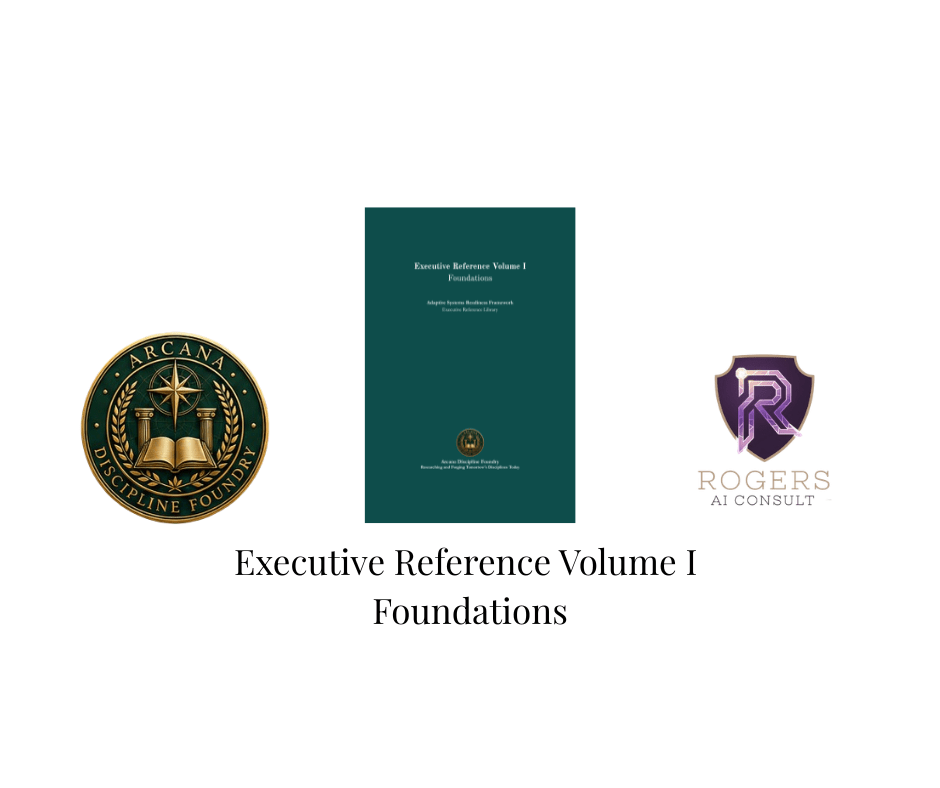
Banner ad for Book Publication - Executive Volume I - Foundations ASRF

The Executive Reference Volume I – Published via Amazon

by V8mondo 19 August 2026

Adaptive Systems Readiness Framework (ASRF)

Executive Reference Library

Volume I : Foundations

  • Establishes the conceptual foundations of organisational transformational readiness.
  • Examines the readiness illusion, organisational coherence, adaptive capacity, governance, and the underlying problem the ASRF addresses.

Volume II : Assessment

  • Focuses on assessing organisational readiness in practice.
  • Develops the diagnostic and assessment architecture, including the conditions affecting governability, adaptive capacity, dependency, continuity, and transformational resilience.

Volume III : Implementation

  • Focuses on applying the ASRF within organisations.
  • Addresses implementation, intervention, governance in practice, maintaining readiness, and translating assessment findings into organisational action.

The Adaptive Systems Readiness Framework (ASRF) : Executive Reference Library is a new body of executive knowledge developed for leaders navigating increasing organisational complexity, accelerating technological change, and strategic uncertainty.

Forged at Arcana Discipline Foundry, the ASRF was developed as a management discipline, for understanding the organisational conditions that determine an enterprise’s continuing capacity to evolve.

Rather than offering another leadership model, or AI implementation guide, the ASRF examines a more fundamental executive question:

What conditions must remain intact, for an organisation to continue adapting successfully as its environment changes?

It is built on a simple, but consequential premise:

“Long-term organisational success is determined, not only by performance, but by the conditions that make sustained adaptation possible.”

The Executive Reference Library develops this premise across three volumes, establishing the foundations of Adaptive Readiness, developing its assessment and diagnostic dimensions, and extending its application into executive decision-making.

Designed as a professional executive reference library, the ASRF series is intended for Boards, executive leadership teams, investors, governance and risk professionals, auditors, transformation leaders, and organisational practitioners seeking a more structured understanding of organisational adaptability, governability, and future capacity.

The ASRF is not designed around a single technology, sector, or anticipated future.

It is designed, around the enduring executive challenge of ensuring that organisations remain capable of responding to futures that cannot yet be fully known.
19 August 2026 0 comments
0 FacebookTwitterPinterestEmail

Beyond Readiness: The Governance Challenge Most Organisations Have Yet to Recognise

by V8mondo 19 July 2026

Over the past year, much of the conversation surrounding artificial intelligence has focused on readiness.

  • Are organisations ready to adopt AI?
  • Do they have the right data?
  • The right governance structures?
  • The right controls?
  • The right policies?

These are important questions. Yet, they may represent only the first stage of a much larger challenge. Most readiness discussions implicitly assume that successful deployment is the destination. In reality, successful deployment may be where the most difficult governance questions begin.

The Readiness Assumption

Across many organisations, readiness is often treated as a point-in-time condition:

  • An assessment is completed.
  • Controls are established.
  • Training is delivered.
  • Technology is implemented.
  • Governance structures are documented.

The organisation is declared ready. From an assurance perspective, this approach is understandable. It provides a basis for decision-making, and creates confidence that appropriate preparations have been made.

The difficulty is that readiness itself is not static.

  • Organisations change.
  • Technologies evolve.
  • Dependencies accumulate.
  • Processes become embedded.
  • Workflows adapt.

What appears ready today, may not remain ready tomorrow.

The Hidden Risk of Success

Many governance failures emerge through obvious warning signs.

  • Control breakdowns.
  • Compliance breaches.
  • Operational incidents.
  • Security failures.

These events attract attention because they are visible. More challenging, are the risks that emerge through successful implementation. As technologies become integrated into operational processes, organisations often experience increasing dependency on the systems they have adopted.

Over time, business processes adapt around those systems, and knowledge becomes embedded within them. Decision pathways evolve, operational routines adjust, then the technology is no longer simply a tool. It becomes part of the organisational environment itself.

This creates a governance question that traditional readiness assessments rarely address:

Can the organisation still adapt effectively once success has been achieved?

The Difference Between Governance and Governability

Most governance frameworks focus on the existence of oversight.

  • Policies.
  • Committees.
  • Controls.
  • Escalation routes.
  • Accountability structures.

These remain essential, however, governance structures alone do not guarantee that meaningful intervention remains practical under real operational conditions. An organisation may retain formal authority to make changes, while finding those changes increasingly difficult to execute without disruption.

In other words, governance can remain present, while governability gradually becomes constrained.

For internal auditors, risk professionals, and assurance leaders, this distinction may become increasingly important.

The question is no longer simply:

“Do controls exist?”

The question becomes:

“Does the organisation retain sufficient flexibility to reassess, adapt, and redirect when circumstances change?”

Why This Matters

Many transformation initiatives are evaluated according to implementation success.

  • Projects are delivered.
  • Budgets are achieved.
  • Performance targets are met.
  • Operational metrics improve.

Yet, successful implementation does not necessarily guarantee long-term organisational resilience. In some cases, success may actually accelerate dependency accumulation. Processes become increasingly synchronised, alternative approaches become less attractive, and operational continuity becomes more valuable. The cost of disruption increases.

Over time, organisations may find themselves operating within increasingly narrow pathways for change, not because adaptation is prohibited, but because adaptation becomes progressively more difficult, expensive, or disruptive.

A New Readiness Question

Traditional readiness asks:

“Can we implement this capability successfully?”

An emerging governance question may be:

“Can we preserve our ability to adapt after implementation?”

This shifts attention from deployment readiness, toward organisational resilience, adaptability, and long-term governability.

For governance, audit, and risk professionals, this perspective introduces a different category of assessment.

It is not simply whether controls exist, nor is it whether compliance obligations are met, but whether the organisation retains sufficient capacity for reassessment, recalibration, and future adaptation under evolving operational conditions.


Executive Takeaway

The organisations that benefit most from emerging technologies may not be those that adopt fastest, nor those that implement the largest number of capabilities. They may be the organisations that successfully balance innovation with adaptability.

Those that preserve the ability to learn, reassess, recalibrate, and change direction when circumstances require it.

Readiness remains essential, but in increasingly adaptive environments, readiness may prove to be only the beginning of the governance challenge.

Arcana Foundry Management Frameworks and Foundry Methodology
19 July 2026 0 comments
0 FacebookTwitterPinterestEmail

Decision Architecture: The First Pillar of AI System Readiness

by V8mondo 26 May 2026

One of the first changes AI introduces into an organisation is not technical. It is structural. Specifically, it changes how decisions are formed and this is often overlooked. Leadership teams tend to focus on capability:

  • What can the system automate?
  • What can it improve?
  • Where can it increase efficiency?

These are valid questions, but they miss a more important one:

How does AI change the decision environment around it?

Because AI rarely operates in isolation, it enters workflows, influences judgement, prioritises information, and increasingly shapes the options people act upon. That makes decision-making itself a system-level issue.

Within the ‘AI System Readiness Framework (ASRF)’, this is the first pillar of, System Readiness: Decision Architecture.

Why Decision Architecture Matters

Every organisation already has a decision system, whether it be formal or informal, clear or fragmented, efficient or slow. AI enters that system and changes its dynamics. It can accelerate recommendations, surface patterns earlier, and reduce manual effort. But it can also create uncertainty.

  • Who validates the output?
  • Who approves the action?
  • Who intervenes when the recommendation appears wrong?
  • Who carries responsibility when outcomes are affected?

Without clear answers, decision quality often declines before it improves, not because the AI is ineffective, but because the decision environment around it has not been designed to absorb it.

AI Changes Decision Flow

Traditional decision-making tends to follow visible pathways:

  • A manager reviews.
  • A team recommends.
  • A leader approves.
  • Authority is easier to locate.

However, AI introduces an additional layer, and recommendations may now emerge from models. Patterns may be surfaced automatically, and risk indicators may be generated before human review.

This changes decision flow, not by removing people, but by altering how people engage with information. When that happens, authority boundaries can blur. This is where decision architecture becomes critical, not to slow AI down, but to stabilise how decisions move through the organisation.

The Six Questions of Decision Architecture

Within the ASRF, decision architecture begins with six practical questions:

1. Where does AI influence decisions? Leaders need visibility.

2. Is AI informing operational activity, strategic planning, customer interactions, or risk decisions?

3. Who retains decision authority?

4. At what point does human authority begin and end? Decision rights must remain explicit.

5. Who approves escalation? When AI introduces uncertainty or conflict, escalation pathways must already exist.

6. Who holds override authority?

The ability to challenge or stop AI-influenced decisions must be clear. These questions are not technical, they are operational design questions, and they become more important as AI scales.

What Poor Decision Architecture Looks Like

When decision architecture is weak, organisations often see familiar patterns, and teams rely on AI outputs without clear validation. Responsibility becomes shared, but ownership becomes unclear. In this case, escalation slows because authority boundaries are uncertain, and decision quality varies across departments. The outcome is that trust weakens.

It is rare that such issues appear during early experimentation. They emerge during operational pressure, and by then, they are more expensive to correct.

Why SME’s Should Pay Attention

For SME leaders, decision architecture is often less formalised than in larger enterprises. That creates both risk and opportunity. Risk, because AI can introduce ambiguity quickly, and opportunity, because decision systems can be redesigned faster.

Smaller organisations can create clearer authority structures, faster feedback, and stronger operational alignment if they design early. This creates execution confidence, and execution confidence matters. Particularly for investors evaluating whether AI-led projects can scale reliably. Because technology alone does not create reliability, decision clarity does.

Decision Architecture as a Leadership Function

Within ASRF, decision architecture is not an operational detail, It is a leadership responsibility. Because leadership defines authority, and it also defines accountability. Leadership defines how decisions move, but AI simply reveals whether those structures are strong enough.

Executive Takeaway

Before AI can improve decision-making, leaders must first understand how AI changes decision-making. That requires design, not just deployment.

Decision Architecture is the first pillar of System Readiness because it establishes the conditions in which AI operates. Without clear authority, approval, escalation, and override mechanisms, AI does not create clarity.

It creates complexity. The stronger the decision architecture, the stronger the organisation’s ability to sustain AI-driven change.

26 May 2026 0 comments
0 FacebookTwitterPinterestEmail

Recent Posts

  • The Adaptive Systems Readiness Framework (ASRF)
  • When Does a Framework Become a Discipline?
  • The Executive Reference Volume I – Published via Amazon
  • The Role of Canon: Why Every Discipline Needs First Principles
  • Where the Adaptive Systems Readiness Framework (ASRF) Was Forged

Recent Comments

No comments to show.

Social Connect

Facebook Twitter Instagram Pinterest Linkedin Youtube

Recent Posts

  • The Adaptive Systems Readiness Framework (ASRF)

  • When Does a Framework Become a Discipline?

  • The Executive Reference Volume I – Published via Amazon

  • The Role of Canon: Why Every Discipline Needs First Principles

  • Where the Adaptive Systems Readiness Framework (ASRF) Was Forged

Categories

  • Adaptive Systems Readiness (1)
  • Artificial Intelligence (1)
  • Disciplines (3)
  • Executive Library (2)
  • Frameworks (4)
  • Governance (4)
  • Leadership (4)
  • Uncategorised (1)
Footer Logo

© 2026  Arcana Discipline Foundry | All Rights Reserved | Researching and Forging Tomorrow's Disciplines Today

Arcana Discipline Foundry
  • Home
  • About Us
  • Frameworks
    • ASRF
    • CGSF
  • Arcana Blog
  • Contact Us